Chem.
Met. Alloys 17 (2024)
13-23
Grygoriy DMYTRIV, Volodymyr PAVLYUK, Ivan TARASIUK,
Ihor CHUMAK, Helmut EHRENBERG, Anatoliy SYNYSHYN, Hermann PAULY
https://doi.org/10.30970/cma17.0440
The interaction of the components in the
Li–Ag–In system was studied in the whole concentration range based on X-ray and
neutron powder diffraction. The crystal structure of the binary compound Li3Ag
was solved and refined from X-ray powder diffraction data. Three ternary
compounds (LiAg2In, Li278(In,Ag)154, and Li2-xAg1+xIn3)
were observed under the conditions of the experiment. The Heusler phase LiAg2In
crystallizes in a MnCu2Al-type structure (Fm-3m, a = 6.5681(5) Å).
The intermetallic compound Li278(In,Ag)154 adopts a
6 × 6 × 6 superstructure of the cubic W-type (F-43m,
a = 20.089(2) Å), and the third compound, Li2-xAg1+xIn3,
crystallizes in an own structure type (Pmma, a = 9.325(3) Å, b = 3.198(1) Å,
c = 8.043(3) Å). The remarkably broad homogeneity
range of the NaTl-type Zintl
phase extending from LiIn into the ternary region was determined and the
distribution of the atoms was obtained from refinements on X-ray and neutron
diffraction data. A wide homogeneity range was also
established for the binary compound Ag3In.
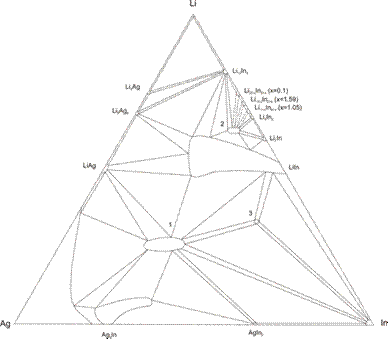
Subsolidus relations
in the Li–Ag–In system (as cast).
Keywords
Phase diagram / Intermetallics
/ Crystal structure / Lithium