Properties of thermally treated Ti/TiO2 nanotubes: increased
crystalline phase and carrier concentration
Chem.
Met. Alloys 16 (2023)
37-42
Olesia SHMYCHKOVA, Tatiana LUK’YANENKO, Alexander
VELICHENKO
https://doi.org/10.30970/cma16.0432
As prepared Ti/TiO2 materials
exhibit a notable presence of X-ray amorphous compounds on the surface, likely
corresponding to hydrated titanium oxides. The primary crystalline phase
observed is titanium dioxide in the anatase form. Traces of metallic titanium
are also found on the surface. There is an increase in the proportion of the
crystalline phase, with a significant rise in the content of metallic titanium,
accounting for approximately one-third of the composition upon thermal
treatment at 500°C for 3 hours in an air atmosphere. Through partial
electrochemical reduction of nanotubes, it is possible to obtain titanium
suboxides with improved electrical conductivity. Subsequent cathodic reduction
of nanotubes for one hour results in the uniform
deposition of a galvanic coating composed of metallic platinum on the material’s
surface. The thermally treated Ti/TiO2 nanotubes exhibit n-type
semiconductor behavior, with a flat-band potential of -0.589 V and a
carrier concentration of 6×1020 cm-3. During
thermal treatment, the flat-band potential and carrier concentration increase,
possibly due to the more crystalline structure of the material. This structural
change is accompanied by an increase in the proportion of metallic titanium,
which acts as an electron donor. A similar phenomenon is observed when a
discontinuous platinum coating is applied to the surface of reduced nanotubes.
In this case, heat treatment causes platinum migration into the bulk of the
composite, which, when dispersed within the oxide, further increases the number
of carriers.
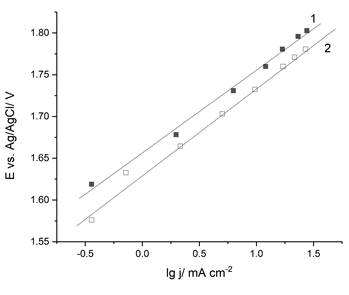
Semi-logarithmic quasi steady-state polarization
curves for reduced Ti/TiO2-Pt nanotubes.
Keywords
Carrier concentration / Thermal treatment /
Phase composition / Nanotubes